





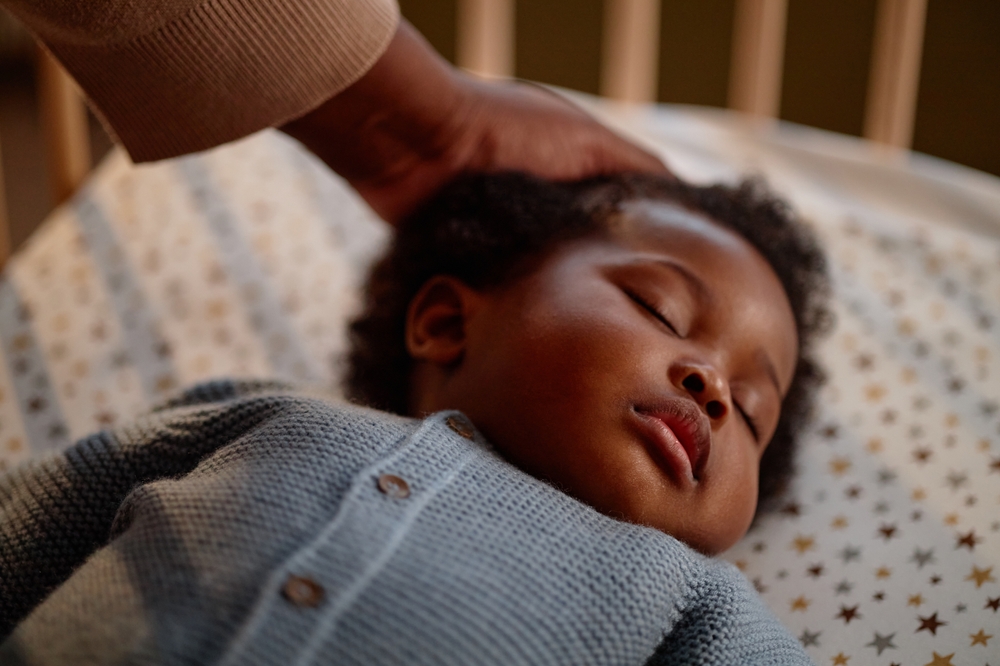
 The holiday season often brings travel, whether it’s to visit family or enjoy a much-needed vacation. For new parents, that can also mean navigating the journey with an infant.
Why safe sleep matters
If there isn’t a safe sleep space ready (like a crib or bassinet) when you arrive, it may be tempting to let your baby sleep with you in the same bed. But the American Academy of Pediatrics (AAP) and Safe Kids Northeast Florida strongly advise against bedsharing. Their guidelines recommend that, until age 1, babies should sleep:

- Alone
- On their backs, and
- Near a parent, but in a separate safe sleep environment, like a crib or bassinet.
Moms often end up bringing their baby into bed to nurse or bottle-feed, explains Jessica Winberry, prevention coordinator with Safe Kids Northeast Florida, which is led by THE PLAYERS Center for Child Health at Wolfson Children’s Hospital. But this can raise the risk of accidental suffocation. Bedsharing is particularly common for breastfeeding moms who are worn out and trying to soothe their little ones while also catching some sleep.
Adult beds can pose serious risks for infants. A baby can get caught in blankets, be accidentally smothered by a sleeping adult, fall from the bed, or become wedged between the mattress and a headboard or wall.
Because new parents are often exhausted, it’s crucial to have every safety precaution in place, Winberry says. Instead of feeding the baby in bed, she recommends getting up and moving to another spot to reduce the risk of accidentally dozing off.
“It’s also important to read instruction manuals for all products to understand what they’re intended to be used for. Remember, the only safe sleep environments are a crib, bassinet, and pack-n-play,” Winberry said. “Items like breastfeeding pillows, rockers, and other types of things are not recommended for a sleeping baby.”
Winberry says there’s a simple fix when you’re traveling: Bring along a packable or portable bassinet. She also shared a few key dos and don’ts to help babies sleep safe and sound — and put parents’ minds at ease.
7 safe sleep tips for when traveling with baby
- Don’t use an old crib. If it hasn’t been used in years, it likely doesn’t meet current safety standards. Extended corner posts, decorative cutouts, and slats spaced more than 2-3/8 inches apart can all pose strangulation risks. Drop-side cribs are no longer considered safe.
- Do place your baby on a firm mattress with a well-fitted sheet.
- Don’t put loose items in your baby’s sleep space. That means no pillows, blankets, or stuffies.
- Do use a sleep sack to keep your baby comfortable and warm. This special zipped garment looks like a sleeper on top, but fans out into a closed sack at the bottom, like a cozy, wearable sleeping bag.
- Don’t let your baby sleep in products not intended for routine sleep, such as rockers, bouncers, swings, or car seats (unless in the car). Always check the product manual for safety warnings.
- Do supervise your baby during long road trips, and stop every few hours to take them out of the car seat.
- Don’t allow your baby to share a bed with another child or a pet. The risks mirror those of bed-sharing with an adult.
Seeking more safe sleep tips for infants?
For additional information on safe sleep, visit wolfsonchildrens.com/safesleep. You can find more safety guidelines for reducing preventable injuries in children by visiting Safe Kids of Northeast Florida, powered by THE PLAYERS Center for Child Health at Wolfson Children’s Hospital.