






I’ve seen the pictures. I’ve read the captions and stories. I’ve sobbed over photos of children whose names I may never know but whose faces I will never forget. I’ve wept for and with their mothers from 6,462 miles away.
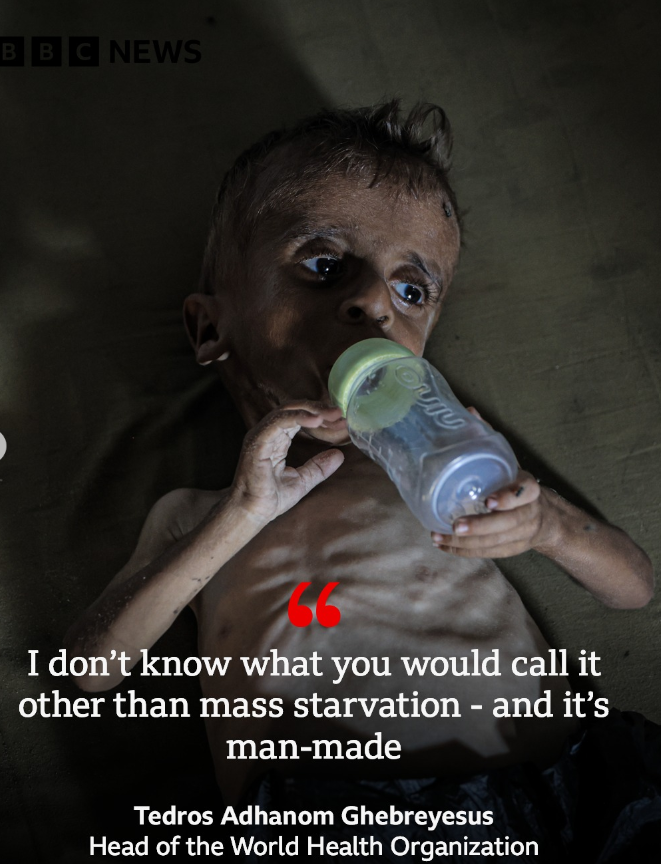
At the time I’m writing this post, the statistics are saying 1 in every 5 people in Gaza are starving and malnourished. This includes children and babies, and according to global experts, the numbers are increasing every day. There are people fainting because of hunger and dehydration. There are mothers who have recently begun resorting to giving their babies salt water because there is nothing else available to give them. Gaza is facing a level of famine that can only be described as devastating and inhumane.
You see, before the current conflict even began, two-thirds of people living in Gaza were already facing food insecurity and depending on food assistance. Which is an important thing to understand in order to really set the scene for the dire reality we’re watching occur today. In March, about four months ago, Israel cut off electricity and halted all aid from entering Gaza — this included food, water, health supplies, fuel, etc. UNICEF has estimated that the children of Gaza have seen a decreased access to drinking water — having access to an estimated mere 1.5 to 2 liters per day. To put that severity into perspective, the World Health Organization recommends 50 liters per day for basic consumption and hygiene, and 3 liters for basic survival.
A report that came out from the Gaza Ministry of Health on July 25, 2025, stated that 27 people had died of hunger in the last three days alone. Which brought the total number of hunger-related deaths to 113 since October of 2023. Of those 113 people, 81 of them were children — that’s 72% of the total deaths.
As of the 81 children who have died aren’t unfathomable enough, the data that came out this week from Doctors Without Borders shows that, “5,000 children were admitted to their clinics with acute malnutrition and, in Gaza City alone, the number of children screened and detected with acute malnutrition is four times higher than what it was in February.”
READ: Look for the Helpers: How to Talk to Your Children About Big Events
The president of MedGlobal, Dr. Zaher Sahloul, points out that this feels like a tipping point where the number of deaths we’re seeing is about to drastically increase because up to 50% of children facing acute malnutrition will die without a massive change. That would be 2,500 children who die in the next few weeks. There are tens of thousands of pounds of food, medicine, baby formula, water, and aid sitting on pallets right outside the city limits of Gaza — and it’s been sitting there so long due to the blockade of incoming aid that much of it has expired. The needed resources aren’t inaccessible — the choice to let it sit on pallets and rot or spoil was just that, a choice. They chose to let babies and children die when the life-saving resources were at their fingertips. It is unacceptable, and if you’re not pissed off yet, you’re not paying attention.
This is not a warning alarm. This is a crisis.
It’s a crisis of reality for the children and parents in Gaza. A crisis of conscious for the global leaders who are watching and choosing not to do every single thing in their power to end this man-made famine. A crisis of humanity for the people across the world who are more committed to the war of grown men than they are to human life itself. Any attempt to justify the starvation and death of these innocent babies and children is indicative of a level of disconnection from human life, morals, ethics, and goodness.
As a mother, I’m continuously finding myself shell-shocked, irate, and absolutely heartbroken. Tears fall from my damp eyes onto the glowing screen of my phone as I read about mothers and their babies who I’m physically separated from by oceans but emotionally connected to through grief and heartbreak.
While I can’t reach them, I can feel them. Because while most mothers cannot fathom the type of anguish that comes from watching your child(ren) fade away, ounce by ounce, every mother around the world knows the anguish of hearing our babies cry about something we have no power to fix.
Is There Anything We Can Do?
1. Use your voice to raise awareness, either in conversations or on social media. If you know who Ms. Rachel is, she is doing a phenomenal job of raising awareness around the issue. Spread truth and facts, not conspiracy theories or political agendas.
2. Donate to organizations that are on the ground in Gaza helping fight this crisis. Do your research to make sure the organization is reputable and verifiably on the ground in Gaza.
3. Call your elected officials and urge them to take action. This includes action to end the blockade, open humanitarian corridors, and provide aid to Gaza. Also, advocate for U.S. foreign policy that supports the delivery of humanitarian aid and encourages the peaceful resolution of the ongoing conflict. 5 Calls is an easy app for finding your officials and calling them.
4. Press corporations to get involved. Encourage U.S. corporations with global presences to take ethical actions, such as using their lobbying capacities to pressure governments to open humanitarian corridors.
5. Raise your children to be educated, kind, and have a sense of global responsibility. Teach your kids about the global challenges that other children face, including the suffering in Gaza. Use age-appropriate resources and teach them the power of compassion and solidarity. Help them understand the importance of empathy and the ways in which small actions can collectively make a huge difference in the world.