

 In 1999, I gave birth to a beautiful baby girl named Paige. I was just 23 — married, young, and barely ready to become a mom. Around five weeks in, my mother gently mentioned that she thought something might be wrong with Paige’s eyes. I dismissed it. Then she brought it up again, and I dismissed it again.
The day before Paige’s eight-week checkup, we took her to visit some family friends. One of them, a physical therapist, made an observation that shook me: “She’s not doing some of the things visually that I’d expect at this age.” Panic set in. At her appointment the next day, I hesitantly brought it up at the very end — still holding onto denial. The pediatrician asked, “Does she smile at you? Does she track you when you walk into a room?” My answers were all no. Within minutes, nurses and doctors were filing into the room. We were immediately referred to Nemours for an MRI and ophthalmology evaluation.

Over the next few years, Paige went through countless tests. We were told she had an underdeveloped macula, rapid involuntary eye movement (nystagmus), and extreme sensitivity to sunlight. She wasn’t blind, but had what they called “low vision.”
I was flooded with questions and fears:
How do you teach a blind baby to eat?
Will she live a normal life?
Will people make fun of her?
Will she ever drive?
One moment stands out that I’ll never forget. I walked into her room while she was swinging and said her name. She jumped — startled. She hadn’t seen me come in. It broke my heart.
But then, progress. One day, I moved a black-and-white striped pillowcase in front of her, and her head turned to follow it. I moved it again — she followed it again. Then we noticed that if we held her very close, she’d smile when we smiled. Tiny, powerful moments of hope.
We were blessed to have a supportive family, including amazing parents, in-laws, and an aunt who was an OT professor and early childhood expert. We were also lucky to have close family friends with visually impaired children who guided us toward early intervention programs and services. That guidance led us through IEP meetings, countless doctor visits, in-home therapy, and support from the Division of Blind Services.
At age 11, Paige’s vision changed again — she developed cataracts and had to undergo three surgeries. That summer was full of restrictions — no swimming, no camps — and too many follow-ups to count.
As she grew older, Paige joined a program for teens with visual impairments that taught real-world skills. It kept her busy throughout high school, along with attending LaVilla School of the Arts and Douglas Anderson, where she majored in piano and played the flute.
Now comes the part of the story that still gives me chills. Paige graduated from UNF with a Bachelor’s degree in 2022 and her Master’s in Healthcare Administration in 2024. She landed a job at Brooks Rehabilitation — specifically in the Low Vision Department — working alongside the very doctor who had helped her for years.
Then, the phone call. Paige called to tell me that her optometrist had fine-tuned her glasses prescription so precisely that… she met the legal requirement to get her driver’s license.
Let that sink in. We had been told her entire life she would never drive.
 Since she was 18, Paige had relied on public transportation — sometimes spending 1.5 hours commuting one way to college, internships, or work. But now, she has been driving safely for over a year. She has a beautiful apartment, a rewarding job at a mental health facility, and a brand-new car she bought herself. Going with her to purchase that car — watching her navigate that entire experience with confidence — was one of the proudest moments of my life.
Her story is one of perseverance, support, and fierce determination. Not every journey looks the same, but I learned early on to trust my gut and lean on others. I wasn’t afraid to ask for help, reach out to experienced parents, or advocate for what Paige needed — even when it wasn’t easy.
Sometimes I had to stand up to Paige, too — encouraging her to do hard things or say no when she wanted a yes. That’s part of being a mom. But ultimately, Paige took the tools, the support, and the challenges — and built the life she wanted.
She is thriving.
 About the Author

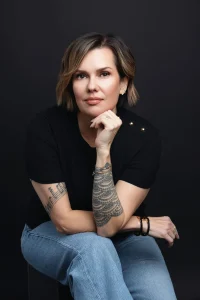
Carrie Wilson is North Florida’s premier makeup artist, widely regarded as the go-to beauty expert for women over 40. With over 25 years of experience in the industry, Carrie worked coast-to-coast in cities like New York, Miami, and Los Angeles, collaborating with top artists, stylists, and creatives in fashion, television, and commercial media.
Carrie is also the founder and creator of Carrie Wilson Makeup, a curated line of high-performance products and professional brushes developed to meet the needs of real women. In 2016, she opened her namesake studio in Jacksonville — a full-service destination offering personalized makeup lessons, private consultations, event services, and exclusive access to her product line.