






I can’t turn away. Every time I cue up Instagram to distract myself from whatever fresh piece of hell January hath wrought — finishing up my stash of holiday charcuterie, for instance — I’m faced with another Ashley Tisdale or Hilary Duff headline. Heck, the husbands are even involved now. It’s that good. And it’s like the 2007 version of me, who religiously refreshed Perez Hilton during the Britney breakdown, has come alive. (But before you @ me, I’m fully aware that mental health issues and petty mom drama are two very different things.)
If you’re not as invested (but still intrigued), here’s the CliffsNotes: In November, Ashley Tisdale, 40, penned a piece on her personal blog called “You’re Allowed to Leave Your Mom Group,” essentially giving others permission to peace out if their group of mom friends has turned “toxic.” The High School Musical star then went on to expand upon her own mom-friend fallout in an essay for The Cut, published last week: “Breaking Up With My Toxic Mom Group,” alongside the tagline, “I thought I found my village. Instead, I was back in high school.” Ashley, mom to two daughters (ages 4 and 15 months), details feeling lucky upon finding connection with a group of mom friends back in 2021 — but it quickly went south.


READ: Are Mom Tribes the New Cliques?
She writes, “Mom groups can turn toxic. Not because the moms themselves are toxic people, but because the dynamic shifts into an ugly place with mean-girl behavior. I know this from personal experience. In my mom group, I started to notice that certain people would get talked about when they weren’t present, and not in a positive way. I realized that there were group text chains that didn’t include everyone, which led to cliques forming within the larger group. And after the third or fourth time of seeing social media photos of everyone else at a hangout that I didn’t get invited to, it felt like I wasn’t really part of the group after all.”

She gives other examples, details an inner dialogue rampant with insecurity (relate), and finally sealed her fate with a text in the group chat: “This is too high school for me, and I don’t want to take part in it anymore.” She recalled, “It didn’t exactly go over well. Some of the others tried to smooth things over. One sent flowers, then ignored me when I thanked her for them.”
Despite a rep for Ashley telling TMZ that this isn’t about a group of certain celebs, my sources (People, Us Weekly, Page Six… all, y’know, reliable) say otherwise. We’re talking Mandy Moore, Meghan Trainor, and Hilary Duff, to name a few. And social media doesn’t lie (jk, it does… but followers don’t lie) — as of this month, Ashley no longer appears to be following Mandy or Hilary on Instagram.
Got your popcorn? Good. Even more shocking has been the husbands’ involvement. Yes, the dads have entered the group chat. Hilary Duff’s husband, Matthew Koma, posted (and then deleted) an Instagram story mocking Ashley, calling her “self-obsessed” and “tone deaf.” Ashley’s husband, Christopher French, then shot back from his high road, “Underrated life skill: Pausing to decide if it’s worth your energy.” Other random celebs also chimed in — Selma Blair, Rebecca Gayheart, and Hilary’s own sister, Haylie Duff, all showed support for Ashley, while Chelsea Handler came to Mandy’s defense.
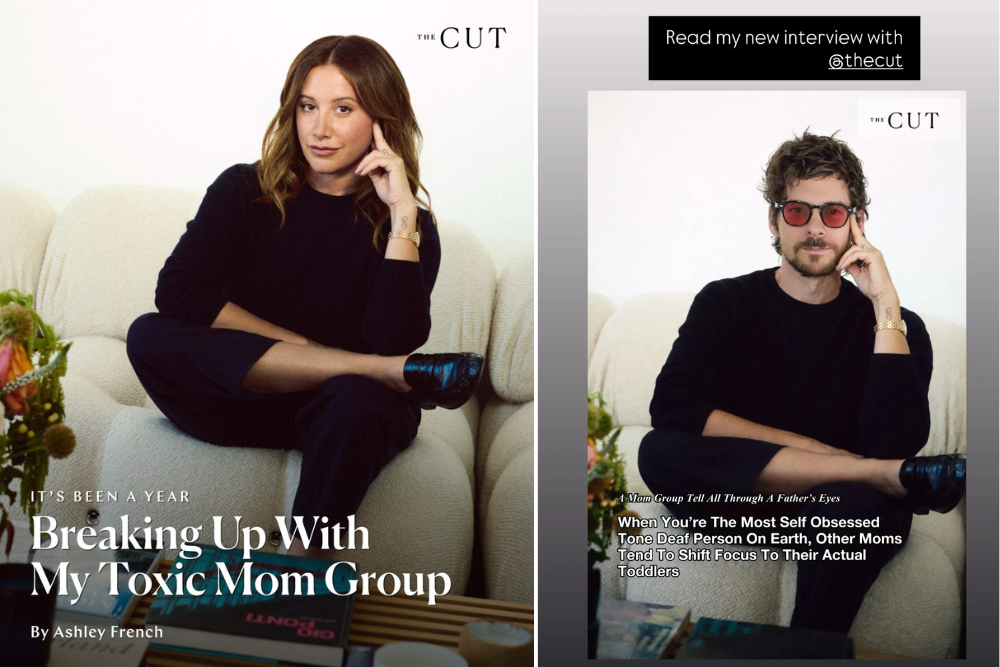
My initial reaction to reading all of this? How hurtful! Poor Ashley. A sensitive, people-pleasing Enneagram 2, I myself have felt left out from time to time. Admittedly, I also partake in my fair share of sh*t talking and know that women can be awful… at any age.
But upon discussing the D-list drama with another mom friend, she didn’t miss a beat and declared, “I think Ashley Tisdale is the problem. I think if you’re publishing an article in The Cut, you’re the problem… and that is mean girl behavior.” Another friend (yes, this was a major topic of conversation for me on Tuesday, don’t judge) immediately agreed: “I think people put too many expectations on other people and don’t take accountability for themselves.”
Wow. All valid points. If you have to question the group chat that’s gone quiet, the non-existent brunch invite, or the unspoken social rules, maybe that’s your cue to step back — and not post more, but care less (cue the ol’ “let them” theory). Adult friendships are messy, complex, and rarely as cut-and-dry as “mean girls” versus victims. Hurt can exist without Cruella de Vil-level baddies, and disappointment doesn’t always mean someone did something wrong.
READ: The 10 ComMOMdments of Solid Friendships
Sometimes the hardest truth to face is asking ourselves what we’re bringing to the table — and what unfair expectations we might be placing on others. Which brings me to this: maybe… just maybe, we actually don’t need Sharpay’s advice on this one.